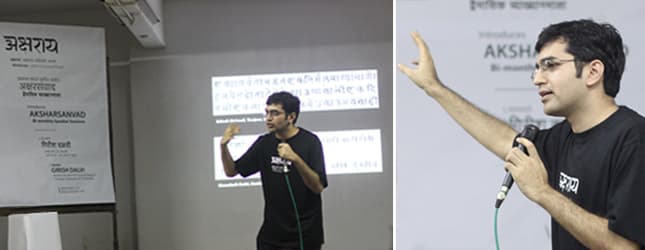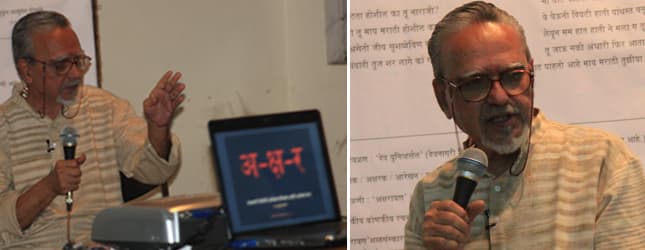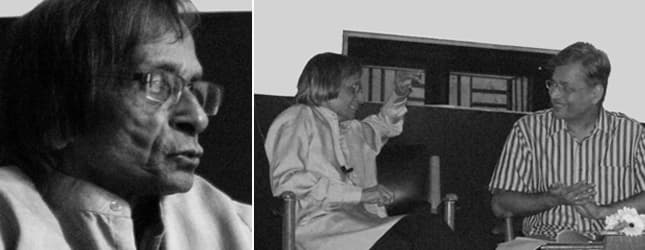
The moment we talk about type or letterforms in general, what one usually sees in the mind’s eye is an image of either handwritten letters or printed text. But in this session of Aksharsanwad, Dr.P.V Radhakrishnan, curator of the Monetary Museum of the reserve Bank of India enlightened us on a very different angle of the subject of typography. He shared with us, his extensive knowledge about Numismatics (the study of coins and currency), in the light of their typographical aspects. Dr. Radhakrishnan has 20 years of experience in Numismatics and he received his doctorate degree in Religious Symbolism in 2010.
The study of Numismatics is one of those highly resourceful fields from which our ancestor’s almost speak to us. The languages, the scripts, the images on the coins, their arrangements and many such aspects of the currency tell us stories about the prevalent culture during the times when that particular currency was in use. There are different kinds of writing systems such as pictographic, ideographic, analytic, phonetic and alphabetic. In India, the earliest evidences of a script are found on the Ashokan Pillars where the teachings of Buddha were inscribed in the Bramhi Script. The Bramhi script is considered to be the first step towards the development of a writing system in the Indian sub-continent. Then came others like the Kharosthi , Gupta, Nagari, Sarada etc.
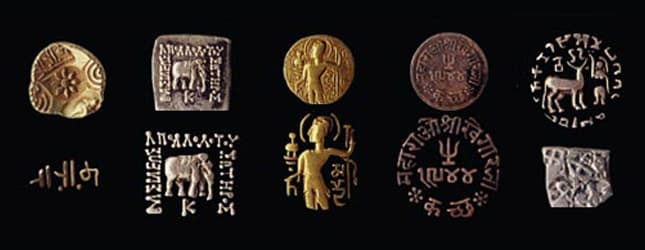
In trade and commerce, the use of scripts and symbols began when the barter system began to fade. Coinage started in india in 600 BC. There are evidences of punch marked coins right from the 2nd century B.C. Coins with punch marked pictures and symbols from the times of different rulers like the Maurya, Janapadas, Nanda etc. have symbols like sun, elephant, carrow, tree, caduceus etc. But it would be incorrect to conclude that these people used pictures because they did not know a script. Rather the pictures were purposely used since these images denoted significant religious meanings commonly understood by the public and making the coins easily acceptable as a medium of communication.
Dr. Radhakrishnan explained that after Alexander’s invasion of north-west India (current day Afganistan, Pakistan and Punjab) bi-lingual coins in Greek and Kharoshti script were issued. The reading direction of the Greek script is clock-wise whereas the Kharosthi script starts from the 3 O’ Clock position and is to be read anti-clockwise, i.e. like reading from the inside. Another Greek coin is square-shaped and its reading direction is from down to up, the beginning point being the bottom left corner. Similarly greek Bramhi coins also existed. These coins helped scholars to reinvent the Brahmi script. There is also another coin having two Indian scripts on a single coin, Kharosthi and Bramhi. This coin is an evidence of trade between north and south India. The first ever numerals appeared on Indian in the form of shaka dates in 101 AD.
Each of the coins that Dr. Radhakrishnan presented before us was a unique one. There was a coin which was wrongly punch cut as an inverse image due to the punch cutter’s manual error and one other that bore 48 characters inspite of being even smaller than 1 cm in size! Other coins included a gold coin with vertical lettering from the Gupta period and coins from the Yadava dynasty of Devagiri in Maharashtra, the Vijaynagar dynasty, the princely state of Gujrat, Assam, Hyderabad, Tamilnadu, Rahapatanam etc. He also showcased examples of several bilingual coins like persian-devnagari, bengali-persian, telugu-tamil, persian coins in tugra calligraphy etc. He then took the audience on a journey from currency in India during the Bristish regime upto the currency that we are using today. The current rupee note has 13 scripts on it.
Dr.Radhakrishnan’s presentation that displayed the variety of scripts appearing throughout the history of Indian Numismatics was simply fabulous. His extensive and deep rooted study of the subject is incomparable. Spell bound by the plethora of information, the audience took home not just a great amount of knowledge and learning but also a desire to visit the RBI monetary museum to gain even more.